
## Built to be ready, not built to react.
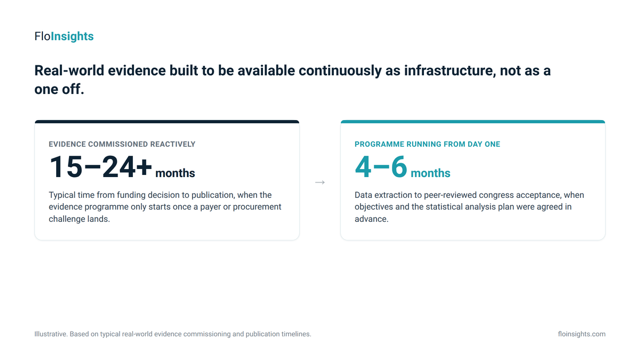
Real-world evidence accepted at international congress within three months of data extraction. That turnaround isn’t luck. It’s what happens when a real-world evidence programme is already running, with its objectives and statistical analysis plan agreed in advance, so the data is ready to be analysed the moment it’s collected rather than designed retrospectively to fit a question someone has just asked.
—–
### Most real-world evidence gets commissioned the wrong way round.
Real-world evidence has to come from real-world use, that part of the sequence can’t change. A product can’t be evidenced in the field before it’s in the field. What can change is when the evidence-generation work actually starts.
Most pharma and device RWE is commissioned reactively, as a bespoke output: a payer challenges a cost-offset claim, a procurement committee asks for outcomes data behind an efficiency argument, a market access reviewer wants to see real-world performance, and only then does anyone go looking for a real-world study. What follows is built under a deadline nobody chose, from whatever data happens to exist: a single site, a retrospective pull, a result that was never designed with a pre-agreed statistical plan to answer the exact question now on the table.
—–
### That’s not a data problem. It’s a planning problem.
The evidence a payer wants usually could exist by the time they ask for it. It doesn’t, because the programme that would have generated it wasn’t running yet. The gap isn’t between having evidence and not having it. It’s between having a programme designed and operating from the point a product enters real-world use, and starting to build one only once someone has already asked the hard question.
—–
### Why this is a September problem, not a someday problem.
Global healthcare financing pressure is shortening the runway between launch and the first serious payer or procurement challenge. Value propositions that could once run for a year or two on a plausible argument are now being tested early. An evidence-generation programme commissioned in response to that challenge starts from a standing start, exactly when speed matters most. One commissioned in advance is already producing results.
—–
### What a programme built to be ready actually requires.
Objectives and endpoints agreed before data collection begins, not selected once the data is in. A statistical analysis plan that governs the analysis from the outset. A standardised methodology applied consistently, so it scales across sites without being rebuilt each time. Independent authorship and interpretation, so what’s produced can be published and defended on its own terms, not just used internally. That’s a materially different commitment than commissioning a study when a payer pushes back, it’s a decision made at launch, not a reaction made under pressure.
—–
### Where this comes from.
This is the same benchmarked evidence infrastructure FloInsights have built inside the global health system: trained on 150+ engagements across 12 countries, running as continuous measurement rather than commissioned on a question by question basis. We’re now extending that same infrastructure directly to pharma and device partners, standing up real-world evidence programmes so the evidence is always there at your fingertips, not assembled in a hurry the day it’s needed.
—–
### Where we’re taking this.
This is the first of a short series. Over the next few months we’ll set out what it actually takes to build a real-world evidence programme designed to be ready rather than assembled to react, and what the reactive version costs the organisations still running it that way.